
The AgentSec Ecosystem, Mapped
A 6-layer coordinate system for identity, delegation, action, enforcement, and audit-grade evidence.

AGENTSEC STACK (A2S)
TL;DR
- AgentSec is not only “model safety”: it is end-to-end governance for agents that can take real-world actions.
- A2S breaks agent security into 6 layers: Identity / Cognition / Orchestration / Action / Enforcement / Evidence.
- Use the map to align architecture and vendor choices: what you’re protecting, where control runs, and what proof you can produce after the fact.
How Agent Risks Cascade
A2S maps what you build to defend agents. CASCADE maps what you're defending against—how a single failure propagates into irreversible damage.
Risk ≈ Likelihood × Blast Radius
Detection reduces likelihood; Governance bounds impact
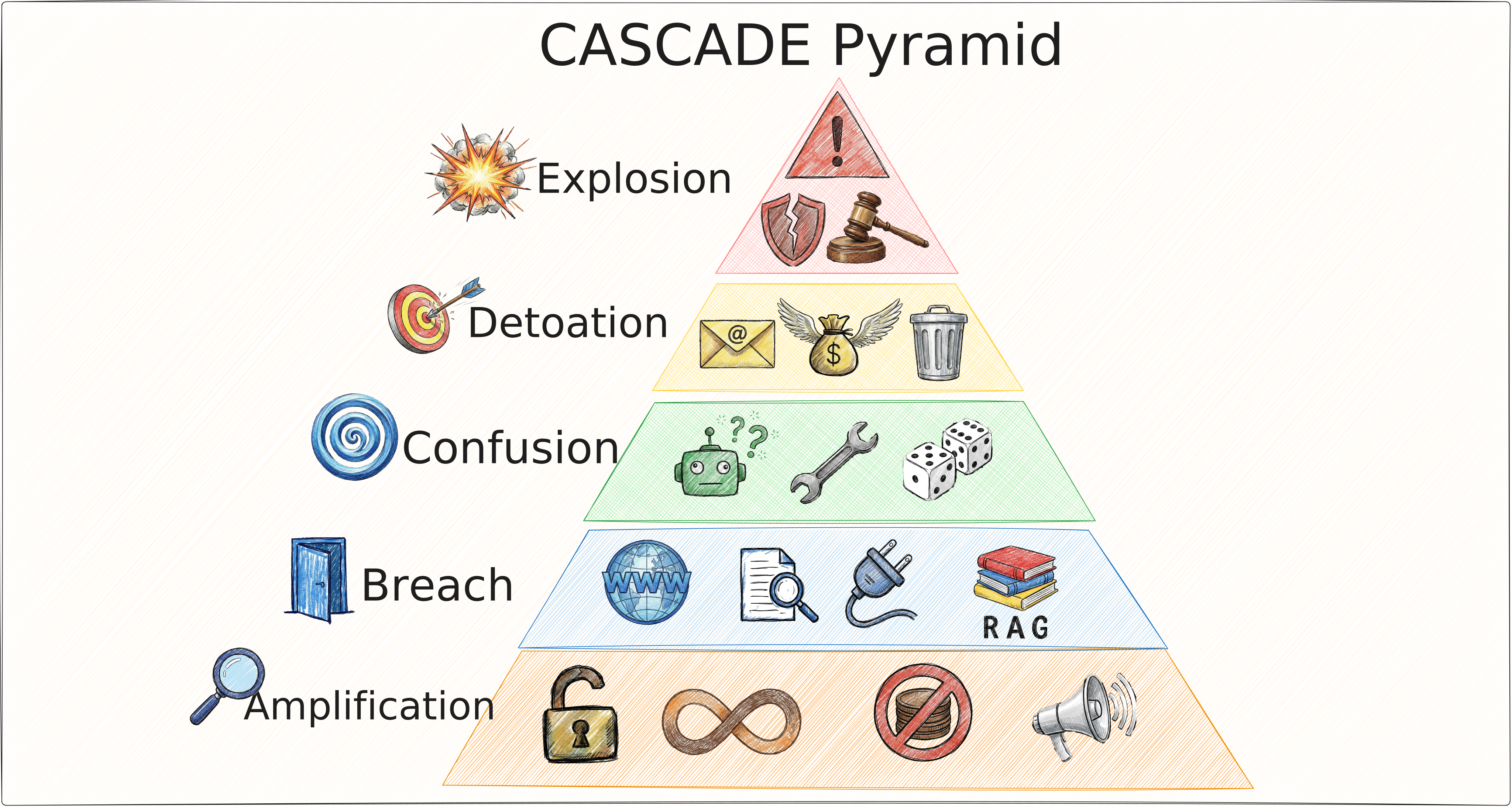
Why "CASCADE"?
Agent security risks are not isolated bugs—they're propagation chains. Untrusted content enters context → shifts decisions → triggers tool calls → causes real consequences.
Each layer represents a stage in the attack chain. Tap or hover the cards below to learn more.
A — Amplification (Posture Gaps)
A — Amplification (Posture Gaps)
Pre-existing weaknesses that determine how far any failure can spread: excessive permissions, no budget limits, no approval gates, no isolation.
B — Breach (Untrusted Content Entry)
B — Breach (Untrusted Content Entry)
The attack surface where untrusted content enters the agent's context: email, web pages, documents, RAG results, MCP plugins, or agent memory.
C — Confusion (Decision Errors)
C — Confusion (Decision Errors)
The agent's reasoning goes off track: hallucination, instruction-vs-data confusion, wrong parameters, or selecting the wrong tool entirely.
D — Detonation (Tool Execution)
D — Detonation (Tool Execution)
The moment risk becomes real: the agent executes a tool call—send email, transfer funds, delete data, fire API requests.
E — Explosion (Irreversible Damage)
E — Explosion (Irreversible Damage)
The end state: financial loss, data leakage, compliance penalties, and cross-system spread. Once reached, consequences cannot be rolled back.
OpenClaw Doctor
Security audit skill for OpenClaw installations. Detects malicious skills, exposed credentials, network misconfigurations, and more — in three phases.
Run in Claude Code to audit your OpenClaw installation.
Three-Phase Workflow
Discovers your OpenClaw installation and enumerates all config files, skills, memory files, and environment files.
Runs 13 modular detection rules against discovered targets across 7 attack surfaces.
Presents findings grouped by severity (CRITICAL → HIGH → WARNING → INFO) with evidence and specific fixes.
7 Attack Surfaces Covered
13 modular detection rules across every layer of your OpenClaw installation.